

Why the future of AI inference lies at the edge
By Stephane Henry, Group VP of Edge AI Solutions at STMicroelectronics,
AI is becoming a transformative force shaping our everyday lives. From wearable devices that monitor our health in real time to autonomous vehicles optimizing driving safety, AI is revolutionizing how we interact with the world.
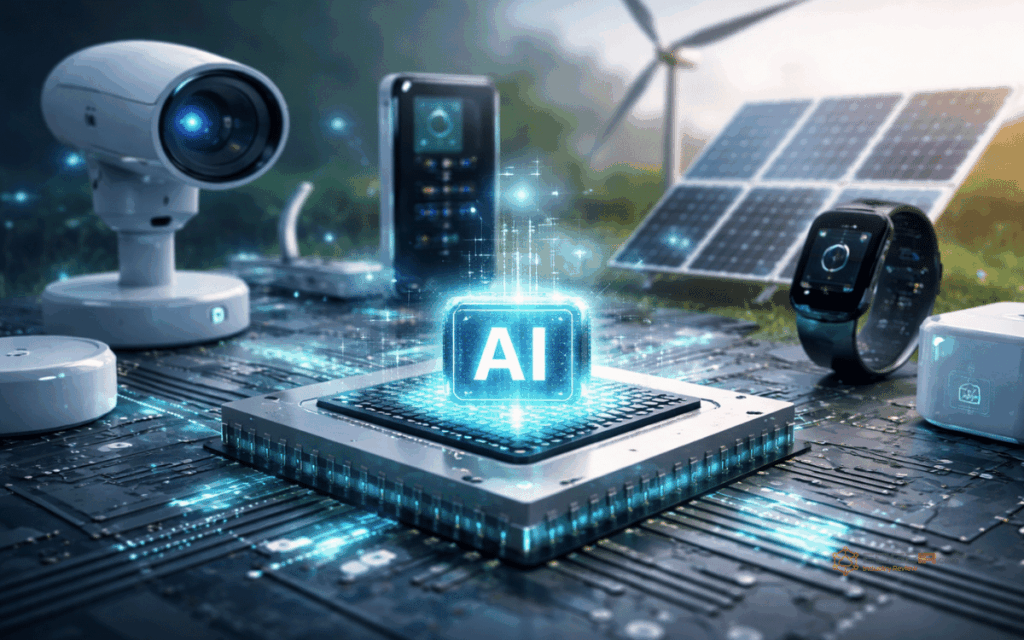
At the heart of this transformation is edge AI, a technology that brings intelligence closer to where data is generated, reducing reliance on cloud processing. This shift is crucial as the world grapples with the challenges of exponential data growth, energy consumption, and sustainability.
The role of semiconductors in an AI-driven world
Semiconductors are the unsung heroes of the AI revolution. They power the chips and sensors that enable AI to function, whether in cloud datacenters or embedded devices. Although considerable focus has been directed towards CPUs, GPUs, and memory architectures that underpin generative AI technologies, energy-efficient microcontrollers (MCUs) with built-in neural processing units (NPUs) and smart sensors play a pivotal role in enabling essential solutions for the development of intelligent, connected systems that harmonize high performance with sustainability.
This transition is accelerating rapidly; according to IDC’s 2026 forecasts, by 2030, 50% of all enterprise AI inference workloads will be processed locally on endpoints or edge nodes rather than in the cloud. This shift is fueling a massive economic expansion, with Grand View Research projecting the global Edge AI market to surge from $25 billion in 2025 to over $118 billion by 2033, driven by the critical need for low-latency, privacy-preserving, and energy-efficient processing.
Why edge AI matters
The global explosion of data is staggering. Transferring this data to centralized cloud datacenters for processing is not only inefficient but also environmentally taxing. For instance, a single query to a large language model (LLM) chatbot can consume up to 10 times the energy of a conventional web search.
Edge AI offers a solution by processing data locally, at the source. This reduces latency, enhances privacy by minimizing data exposure, and empowers user control over personal information. It also minimizes energy consumption.
Intelligent sensors: Bringing AI to the source
One of the most exciting advancements in edge AI is the integration of intelligence directly into sensors. These “smart sensors” can process data locally, enabling real-time decision-making while conserving energy. Hardware processing engines like Machine Learning Core (MLC) are a prime example, offering highly efficient event detection capabilities with minimal power consumption.
Further innovations, such as in-memory computing (IMC), are pushing the boundaries of what edge devices can achieve. By combining data storage and computation in the same memory unit, IMC drastically reduces energy consumption and speeds up processing. These technologies are transforming everything from motion sensors in wearable devices to image sensors in cameras, making them smarter and more capable.
Contextual awareness: The next frontier
Continuous contextual awareness is frequently required around the clock. Achieving this with conventional cloud-based methods is unsustainable and remains highly challenging even when handled locally on edge devices. Edge AI excels in this domain by enabling use cases like smart building occupancy monitoring, automotive driver monitoring systems, predictive maintenance or even agricultural pest and disease detection, that were once unattainable, all while offering a much more sustainable solution.
AI in general is becoming more contextually aware, meaning it can better understand and respond to its environment. This is achieved by integrating data from various sensors, such as cameras, motion detectors, and temperature sensors, and processing it locally using advanced AI algorithms.
For instance, humanoid robots equipped with edge AI can perform localized sensing and inference, enabling them to adapt to their surroundings. With context-aware behavior, a robot can dynamically adjust its actions, such as navigating around obstacles, responding to a user’s emotional state, or modifying its speech and gestures to suit the social context. By incorporating large language models and persistent databases, these systems are evolving to learn, reason, and make decisions autonomously.
A sustainable future for AI
As AI technologies and tools evolve, sustainability remains an absolute necessity. The semiconductor industry is leading the charge by developing energy-efficient solutions for both cloud and edge computing. Advanced manufacturing processes deliver unprecedented performance while reducing power consumption through reduced voltage and leakage currents.
Innovations are driven in intelligent sensors, in-memory computing, and edge AI tools. These advancements not only make AI more efficient but also enable smarter, more sustainable products that bridge the gap between low-power embedded devices and high-performance cloud systems.
Complementing these hardware advancements, the software and tooling ecosystem has also undergone significant evolution. This progress has been instrumental in making embedded AI a practical reality. Sophisticated neural network models, which previously required the computational power of servers, can now be dramatically optimized to function within the resource constraints of embedded devices. Methodologies such as quantization and pruning reduce a model’s memory footprint and computational requirements.
Moreover, the accessibility of AI development has broadened considerably. Advanced toolkits now automate complex optimization tasks, enabling more developers to train and deploy efficient models. To complete the ecosystem, semiconductor manufacturers provide dedicated software that translates these models into highly efficient code, tailored for their specific hardware. This crucial integration of software and silicon is a primary driver of innovation in intelligent, embedded devices.
The evolution of edge AI is paving the way for a smarter, more connected, and sustainable future. By bringing intelligence closer to the source of data, edge AI is transforming industries, enhancing privacy, and reducing energy consumption.
From intelligent sensors to in-memory computing, the technologies driving this revolution are enabling a world where AI adapts, learns, and evolves, making our lives better through more efficient and sustainable use of resources.
About the author
Stephane Henry is Group VP of Edge AI Solutions at STMicroelectronics, responsible for the development of AI technologies, tools and model libraries for embedded microcontrollers and microprocessors.
Article Topics
AI inference | AI infrastructure | edge | edge AI | edge computing | embedded AI | intelligent sensors | semiconductors

Comments